Showing posts with label bushman. Show all posts

Monday, September 9, 2013

The Lion: Character design (part 1)

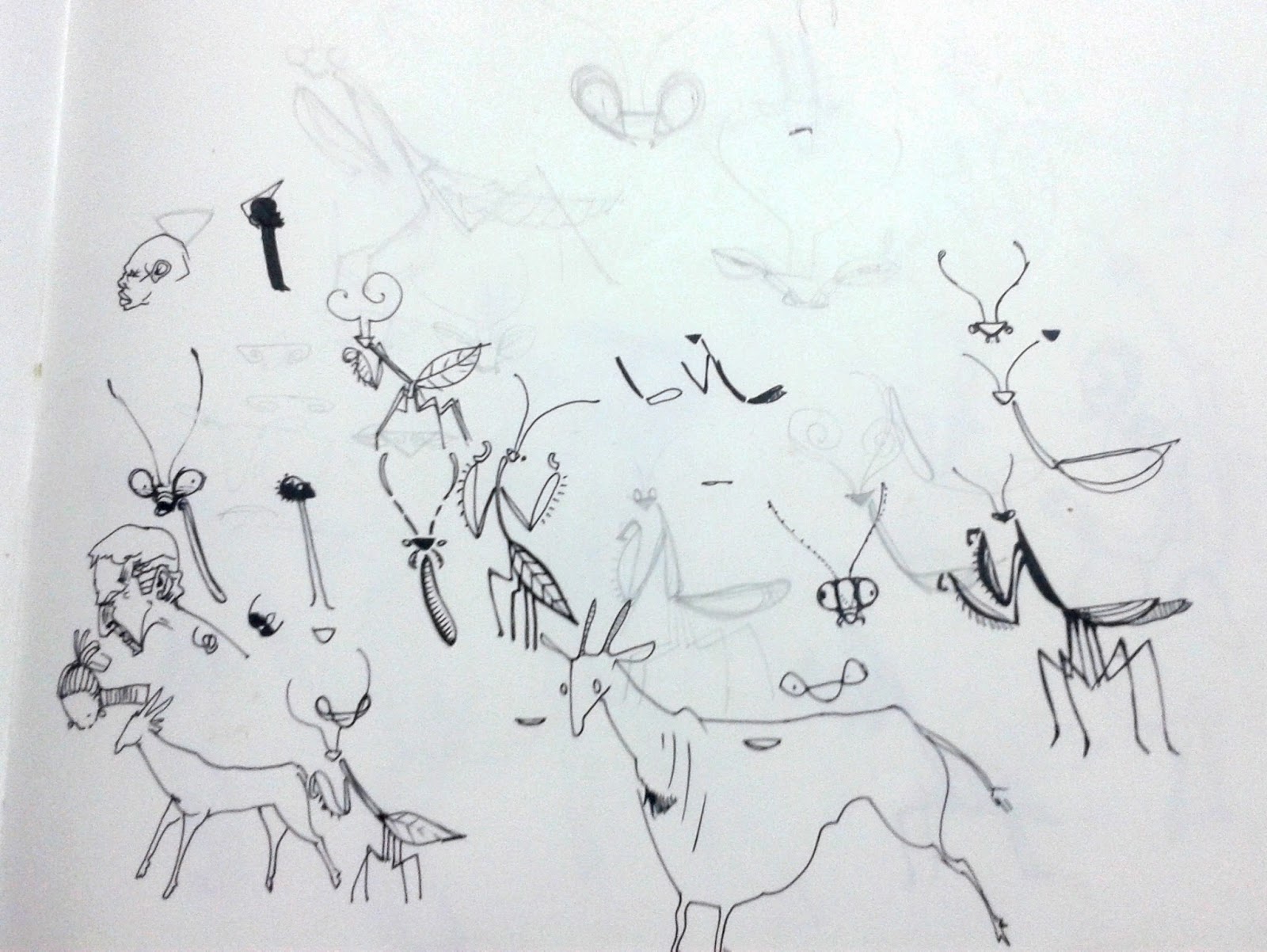
The lion, the king of the jungle and of all beasts, hold a very different position in Khoisan culture. Fables around the world depict the lion as the strong and mighty master of the wild. However in Khoisan folklore, the lion is of a rather naive and foolish character. The lion is seldom the one that triumphs at the end of the story. In one bushman folktale, a pack of jackals triumph over a lion through their wits. 
The jackals said that he seemed to be a strong thing,but he was really only a little thing who had not been able to resist a small stone."- The Lion and the Jackal
Lions are also frequently represented in the rock paintings. Knowing the bushman belief of shaman's transforming into various animals during trance, it is not surprising that it was believed that shamans could turn into lions.Lions were "believed to have some of the shamans' accomplishments: they knew things that ordinary people could not possibly know, they could become invisible, and they could cause things to happen by supernatural means." (source: Images of Power, D.L Williams and T.Dowson.)
According to bushman sources, sometimes evil shamans would come prowling in their feline forms. Invisible to ordinary eyes, these evils spirits can only be warded of by another shaman. It is very fascinating to compare the two striking ways the bushman depict the lion. A powerful animal, ferocious and strong yet foolish and naive in behaviour. It has strong shamanic powers yet not as powerful as an eland. The Khoisan understanding of the lion poses a very beautiful juxtaposition that values mind over might. 


Sunday, August 25, 2013

Tuesday, August 20, 2013

Top 5 significant Bushman animals

Bushman cave paintings are full of animal metaphors and therianthrope characters. However among the various animals that do feature in their paintings there are certain which hold special position in Bushman culture. Here is a list of the TOP 5 significant bushman animals, in random order.

An Eland
1. Eland: The eland, the biggest antelope of Southern Africa, is the chief of all animals according to bushman culture. It was also /Kaggen, the mantis', first creation (see: Mantis makes an Eland) and was it's most dearest creation. The bushmen hold the eland in the highest regard and claim it is the most potent of all the animals. The eland is significant for all the important rituals of the bushmen; Inititation, Puberty rites, first menstruation, marriage etc. It is also called the rain animal. Shamans often try to harness the potency of the land in their rainmaking rituals.
Often a shaman's trance experience (dying) is paralleled to the death of an eland. The behaviour of a shaman in trance is very similar to moments after an eland is shot. The shaman like a dying eland bleeds form the nose, staggers and lowers his head and eventually falls down unconscious. All these features simply put the eland on top of the list and makes it the chief of all the animals in Bushman culture.

An Hartebeest
2. Hartebeest: The Hartebeest is one of the most painted animals in the cave paintings. It is another of /Kaggen's creations and bears a strong resemblance to a mantis. Bushman talk of /Kaggen sitting atop a Hartebeest, between it's antlers, while moving about in the wild.

"He made his heart of the eland and the hartebeest. The hartebeest and the eland are things of the Mantis; therefore they have magic power."

3. Rhebuck: Rhebucks often appear in cave paintings as animals in their true form or as therianthropes. There are several depictions of shamans with rhebuck heads and hooves for legs. Rhebucks are said to have powers like that of a shaman. 'Men with rhebuck heads...tame elands and snakes' said one bushman informant.

4. Elephant: Apart from antelopes, elephants and other pachyderms like rhinoceroses, hippopotamuses do appear in bushman cave paintings. Sometimes therianthropes with elephantine features may appear instead of whole elephants. Therianthropes with protruding tusks and trunks are often appear in the cave paintings, as seen in the illustration below. Elephant drawings are usually seen surrounded by entoptic dots which prove it may have been a shaman's vision during the trance dance.

Therianthrope with a rhebuck head

Elephant theriathropes


5. Baboon: The baboon is revered sacred as it bears the closest resemblance to humans. The baboons are said to have powers like that of a shaman: predicting danger, protection from sickness etc. The baboons were said to derive their powers from the stick of a sho:/õӓ plant. The plant cannot be identified but it is described as a plant with a red top and long roots.

Apart from these animals there are several other animals that appear in San rock paintings: snakes, fish, jackals/ foxes, crabs, birds, lions etc. Every animal plays a unique role in the paintings they appear. For instance, fish and birds act as metaphors to illustrate the underwater/ flying trance experience. Snakes are one of the forms that the Mantis assumes to scare hunters during game hunts. Foxes, contrary to their cunning reputation in other cultures play a very protective guardian figure role in bushman mythology. Many times shamans are believed to assume the form of a lion and go on out-of-body journeys. 

Images of Power


Cave paintings from the Drakensburg mountains

Inspired by Saki Mafundikwa's attempt to revive an authentic African visual identity, I decided to explore the possibilities of a Khoi-San visual language. The Bushman cave paintings are one of humankind's first acts of creation and they have been my biggest source of inspiration in this endeavor.
What fascinates me the most about the bushman Rock art are the subtleties of Bushman religion and mythology that's infused in these paintings. Earlier derided as works of a community "once despised and considered by many Westerners to be on the lowest rungs of human evolution"  bushman rock art has been found to have been more complex and advanced than the Upper Palaeolithic art found in French and Spanish caves. Contrary to earlier notions, Bushman cave painting are more than mere decoration and hunting scenes, recent rock art research has found them to have a deeper and a more spiritual role to play in bushman culture. The book 'Images of Power-David Lewis Williams and Thomas Dowson' had been my primary source of information in this regard taking me step by step through the many layers underlying in the works of ancient bushman.
Most of the ancient cave paintings are believed to have been painted by the shamans of the communities, illustrating their experiences during their trance dance. The cave walls were not just seen as blank canvases but as a portal into the spiritual realm. It is seen as a window into a world that exists behind the face of the rock. I was amazed to see the resemblances modern day fantasy has to ancient ideas as reflected in these cave paintings. How different was it from the magical world behind 'Platform 9 3/4' from the Harry Potter mythology?
Bushman mythology is full of such symbols and metaphors that we find reappearing in our modern day fantasy fiction. Below is a mind-map charting out the various features of bushman cave paintings.

Mindmap about bushman rock art

The bushman often refer to their trance experiences as 'dying', just like how in western colloquial terms it is referred to as a 'trip'. The shamans use several metaphors to describe their trance experiences, one of them being 'drowning'. The shamans relate their trance to the feeling of being underwater; blurry vision, difficulty to breathe, weightlessness etc. Some refer to it as flying, very similar to how we often call it being 'high'. Bushman paintings are also full of animal  metaphors and therianthropes, which almost blurs the gap between man and animals. Bushman believe a shaman in trance can embody and harness another animal's potency. To them the Eland is the most potent animal, often referred to as the Rain Animal. Many shamans describe possessing animal features during the trance, which can be understood through the several Therianthropic (humans with animal features) characters in the paintings.

Next post: Top 5 most significant bushman animals.

Therianthropes
Sources: Images of Power: David Lewis Williams and Thomas Dowson.
Bradshaw foundation website: http://www.bradshawfoundation.com/rari/


Monday, July 29, 2013

The call to adventure...


Joseph Campbell
The Heroes Project is inspired by Joseph Campbell's work in the field of mythology, especially his theory of the hero's journey. Campbell articulated the Monomyth, a common myth found in mythologies around the world, which talks of the universal myth of the hero's journey.

According to Campbell the hero’s journey begins with one responding to an inner voice, ‘a call to adventure’ that demands sacrifice and a journey to the unknown. The Hero embraces this adventure and embarks on a journey of self-realization, which once endured s/he returns to narrate the tale to others with the idea to communicate his/her lessons from the journey that can be useful to others to negotiate their present day reality. Campbell says a Hero passes through three typical stages in his journey: Initiation, Separation and Return.
"The usual hero’s adventure begins with someone from whom something has been taken, or who feels there’s something lacking in the normal experiences available or permitted to the members of his society. This person then takes off on a series of adventures beyond the ordinary, either to recover what has been lost or to discover some life-giving elixir. It’s usually a cycle, a going and a returning."
-Joseph Campbell, The Hero With A Thousand Faces.
Using this universal framework and the myths of the Khoi-San, we aim to give back the Khoi-San their heroes; rooted in their own culture, tradition and history. The heroic stories of Khoi-San ancestors will instill pride, courage and hope in the minds of the Khoi-San to challenge the hurdles earlier deemed impossible. The myths and stories of a hero’s journey give people a figure to believe in, something which acts a projection of a resolution to their struggles. The hero's journey model finds itself across all cultures primarily because it is a story that people relate to. The classic story of overcoming all odds to achieve what earlier seemed impossible.