 |
| Jackal: The Watchful Guardian |
Showing posts with label Cave paintings. Show all posts
Showing posts with label Cave paintings. Show all posts
Tuesday, September 10, 2013

The Jackal: Character Design (part 1)
 |
| Jackals in Bushman rock painting |
The Jackal was another frequently represented in the Bushman rock art. The Jackal was another that the shamans were believed could transform into. What was the most fascinating fact about the significance of the jackal in bushman culture was the contrasting position the jackal held in Bushman culture. The jackal or the fox is notorious is cultures around the world as the sly and cunning mischief makers. They are seldom the heroes of a story, often playing the antagonist role. For instance the famous story of the Blue Fox/Jackal or the character Tabaqui from the Jungle Book, the mad-cowardly jackal who eats the remains of Sher Khan's food. The Jackal has often played the anatagonist or the negative sidekick in popular fables, but not in bushman folklore. According to a /Xam person, 'the jackal is a sorcerer' who follows people when they are on hunts to ensure their safety. It follows them to make sure they are safely on their way home.
At night, while are encamped on the way home, he barks, and they know that 'he is asking us whether we are still as well as we were when we left him'. They shout out to him,'There is nothing the matter with me, for I am still feeling as I did when I left you.' - Passage from Images of Power, D.L Williams/ T.Dowson
Such stories alleviate the Jackal to almost a guardian figure, always looking out and ensuring the safety of it's children. Possessing powers of a sorcerer, makes the Jackal a very significant mythological figure in bushman culture. This became the inspiration behind the third super-therianthrope in my story.
Monday, September 9, 2013
The Lion: Character design (part 1)
The lion, the king of the jungle and of all beasts, hold a very different position in Khoisan culture. Fables around the world depict the lion as the strong and mighty master of the wild. However in Khoisan folklore, the lion is of a rather naive and foolish character. The lion is seldom the one that triumphs at the end of the story. In one bushman folktale, a pack of jackals triumph over a lion through their wits.
 |
The jackals said that he seemed to be a strong thing,but he was really only a little thing who had not been able to resist a small stone."- The Lion and the Jackal |
Lions are also frequently represented in the rock paintings. Knowing the bushman belief of shaman's transforming into various animals during trance, it is not surprising that it was believed that shamans could turn into lions.Lions were "believed to have some of the shamans' accomplishments: they knew things that ordinary people could not possibly know, they could become invisible, and they could cause things to happen by supernatural means." (source: Images of Power, D.L Williams and T.Dowson.)
According to bushman sources, sometimes evil shamans would come prowling in their feline forms. Invisible to ordinary eyes, these evils spirits can only be warded of by another shaman. It is very fascinating to compare the two striking ways the bushman depict the lion. A powerful animal, ferocious and strong yet foolish and naive in behaviour. It has strong shamanic powers yet not as powerful as an eland. The Khoisan understanding of the lion poses a very beautiful juxtaposition that values mind over might.

Sunday, August 25, 2013
Character Designs- initial sketches
 |
| Attempts at developing a visual style. |
 |
 |
| The Mantis and his friends. |
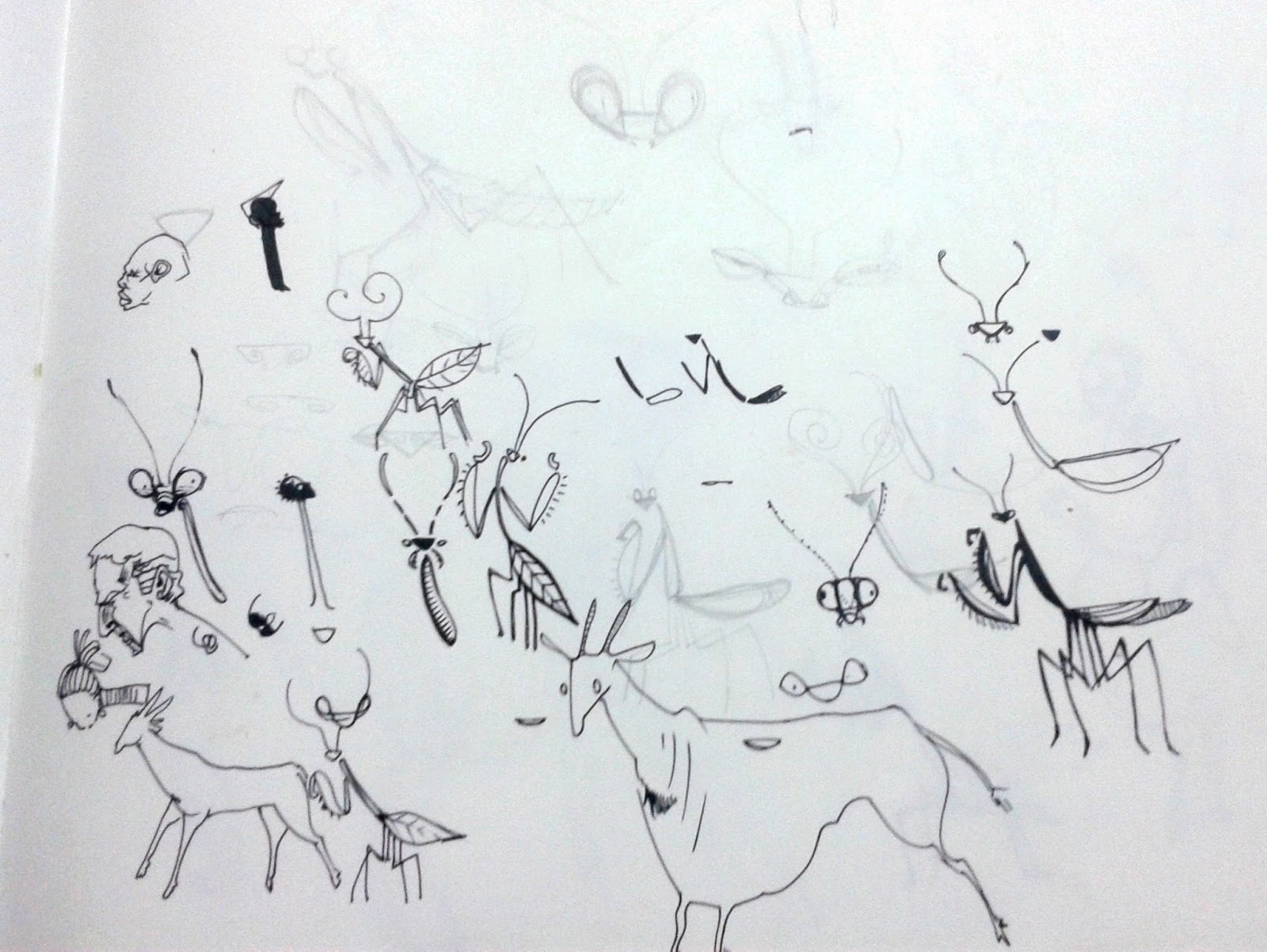 |
| The many faces of /Kaggen , the mantis. |
Tuesday, August 20, 2013
Top 5 significant Bushman animals
 |
| An Eland |
Often a shaman's trance experience (dying) is paralleled to the death of an eland. The behaviour of a shaman in trance is very similar to moments after an eland is shot. The shaman like a dying eland bleeds form the nose, staggers and lowers his head and eventually falls down unconscious. All these features simply put the eland on top of the list and makes it the chief of all the animals in Bushman culture.
 |
| An Hartebeest |
"He made his heart of the eland and the hartebeest. The hartebeest and the eland are things of the Mantis; therefore they have magic power."
3. Rhebuck: Rhebucks often appear in cave paintings as animals in their true form or as therianthropes. There are several depictions of shamans with rhebuck heads and hooves for legs. Rhebucks are said to have powers like that of a shaman. 'Men with rhebuck heads...tame elands and snakes' said one bushman informant.
4. Elephant: Apart from antelopes, elephants and other pachyderms like rhinoceroses, hippopotamuses do appear in bushman cave paintings. Sometimes therianthropes with elephantine features may appear instead of whole elephants. Therianthropes with protruding tusks and trunks are often appear in the cave paintings, as seen in the illustration below. Elephant drawings are usually seen surrounded by entoptic dots which prove it may have been a shaman's vision during the trance dance.
 |
| Therianthrope with a rhebuck head |
 |
| Elephant theriathropes |
5. Baboon: The baboon is revered sacred as it bears the closest resemblance to humans. The baboons are said to have powers like that of a shaman: predicting danger, protection from sickness etc. The baboons were said to derive their powers from the stick of a sho:/õӓ plant. The plant cannot be identified but it is described as a plant with a red top and long roots.
Apart from these animals there are several other animals that appear in San rock paintings: snakes, fish, jackals/ foxes, crabs, birds, lions etc. Every animal plays a unique role in the paintings they appear. For instance, fish and birds act as metaphors to illustrate the underwater/ flying trance experience. Snakes are one of the forms that the Mantis assumes to scare hunters during game hunts. Foxes, contrary to their cunning reputation in other cultures play a very protective guardian figure role in bushman mythology. Many times shamans are believed to assume the form of a lion and go on out-of-body journeys.
Subscribe to:
Posts (Atom)